
Why Gold Buyers Give Different Prices — and How to Make Sure You're Never Shortchanged
You checked the gold rate online. You visited three buyers. You got three completely different prices. And now you don’t know who to trust. Sound familiar? You’re not alone — and this article will show you exactly why this happens and how to make sure you never get scammed again.
Alok Parmar
June 09, 2026
Article Index
How to Reclaim Your Power: Steps to Get the Right Price
What Is Gold Resale Pricing — and Why Is It So Confusing?
You checked the gold rate online. You visited three buyers. You got three completely different prices. That's the question this article answers: why do gold buyers give different prices, and which number can you actually trust? The formula looks simple on paper
Final Price = Total Weight × Live Gold Rate
But each of those three variables can be adjusted in ways that are genuinely hard to spot. Add buyer margins, stone deductions, and testing methods, and two buyers looking at the same ring can be thousands of rupees apart. Here's exactly what's happening
To understand how gold prices are calculated in more detail, click on the link below
#############################
The 6 Real Reasons Gold Buyers Give Different Prices
1
The Live Gold Rate They Use
A buyer can quote a high live rate as an anchor to pull you in and then recover that apparent generosity through aggressive deductions elsewhere — a practice called the ‘anchor strategy’.
The rate quoted is rarely the rate you’re paid on. Always ask for the full price breakdown, not just the opening rate.
2
The Melting Trap
Some buyers will tell you: “We need to melt it to check the purity and give you a price.” This is a red flag. Once your jewellery is melted, you’re committed — you can’t take it back to another shop for comparison. This technique is often used to manufacture a pricing advantage by creating an exit barrier. A legitimate, trustworthy gold buyer will always offer non-destructive purity testing upfront.
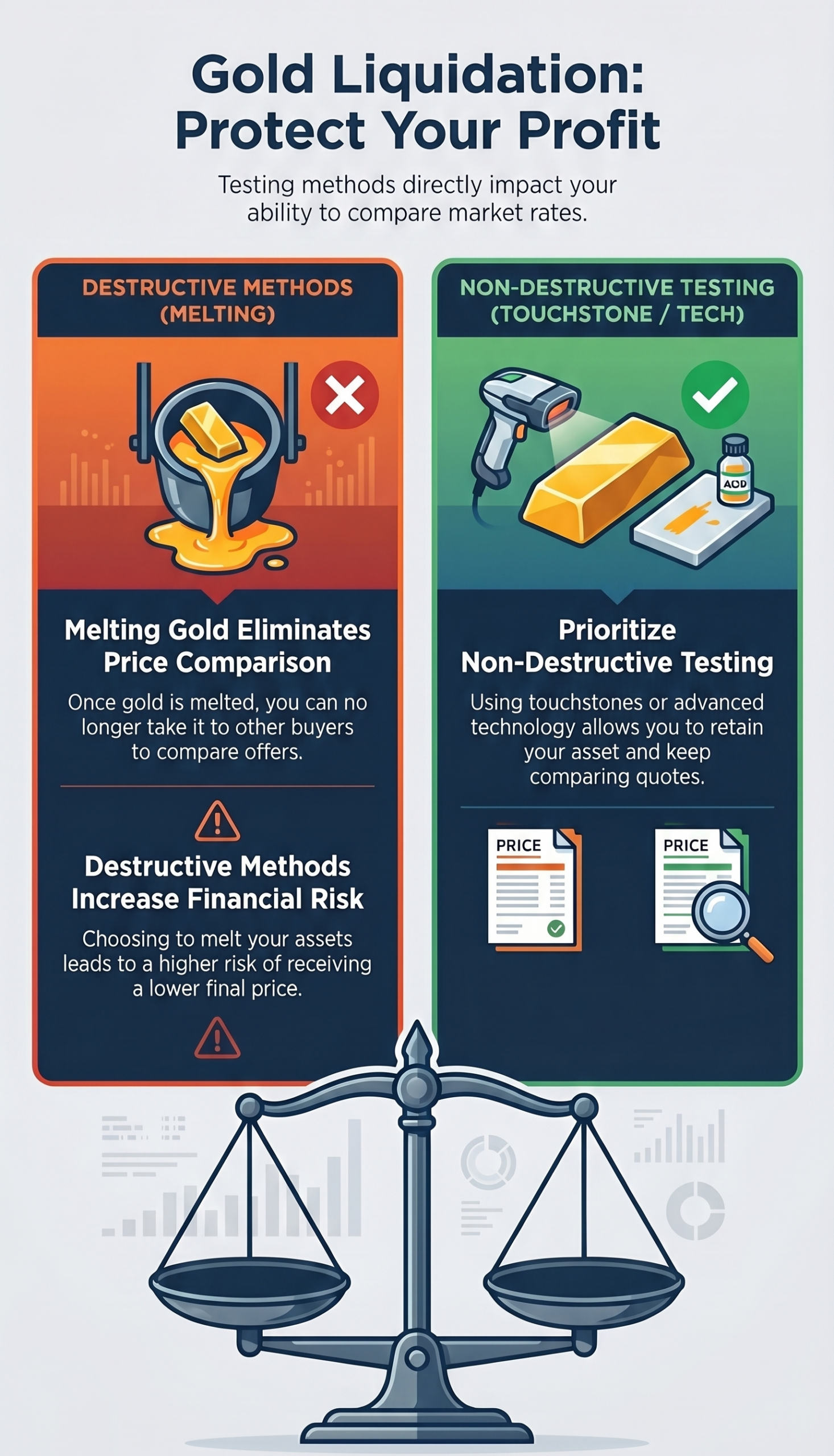
At AsliValue, we use non-destructive testing methods so customers can evaluate their gold without being forced into immediate selling decisions.
3
Stone and Wastage Deductions
Most gold jewellery contains non-gold elements: gems, stones, enamel, soldering material, or dirt. A fair buyer will deduct only the verified weight of these non-gold materials.
However, some buyers:
● Apply excessive “wastage” or “melting loss” charges
● Deduct for dirt and for melting loss, effectively charging you twice (the Double Deduction trap)
Always ask, “What is being deducted and why?” A fair buyer will walk you through this live, in front of you.
To understand different margins and deductions in more detail, click on the link below.
#######################
4
The Business Model of the Buyer
Not all gold buyers want the same thing from the transaction. Their business model directly shapes the price they offer.
● Local jewellers mainly focus on selling new jewellery, so gold buyback is usually a secondary activity for them. Because of this, they may offer lower prices to maintain higher profit margins.
● Exchange brands primarily aim to get customers to trade old gold for new jewellery designs. They may offer moderate rates, but these are often linked to exchange-only deals.
●Organized gold buyers specialize specifically in buying gold. Due to higher transaction volumes and more streamlined processes, they generally tend to offer better gold rates.
Specialized gold buyers, like AsliValue — businesses whose only job is buying gold — operate on standardized margins and higher transaction volumes. This means less process wastage and more value passed back to you.
5
Information Asymmetry
The gold resale industry has historically thrived on the fact that most customers don’t know how to verify the math. If you can’t independently calculate purity × weight × rate, you’re relying entirely on the buyer’s honesty.
This is why transparency in process matters more than the rate quoted at the door. Demand to see every step: weighing, purity testing, stone deduction, and final calculation — all in front of you.
6
Margins and Operational Costs
Every buyer has overhead: rent, staff, equipment, and profit margin. These costs are recovered from the spread between what they pay you and what they get when they sell the refined gold.
A buyer with lower operational efficiency or higher overhead will typically offer you less. Businesses that handle large gold volumes can afford tighter margins — which benefits you directly.
How to Reclaim Your Power: Steps to Get the Right Price
1
Demand the Math Before melting or selling
If a buyer tells you they must melt your ornaments just to give you a rate, be cautious. This “Melting Trap” is often used to create a commitment—once your jewellery is a lump of metal, you are far less likely to take it to a different shop to compare.
2
Choose Specialists Over Generalists
A local jeweller might offer a lower gold rate because they view buying as a secondary support activity. Specialized liquidity businesses treat the gold selling process as their primary focus.
Volume Benefits: Because specialists handle larger volumes of gold, the impact of “process wastage” is lower, allowing them to pass that value back to you through a better final price.
3
Beware the “Double Deduction”
Watch out for buyers who weigh your gold without cleaning it first. If they apply a “dirt deduction” and a “melting charge,” they are effectively charging you twice for the same impurity. A fair buyer will provide a standardized framework for these charges.
You've just learned how buyers manipulate prices. Here's what a transparent one looks like
.At AsliValue, every evaluation happens at your home. You see the weight. You see the purity test. You get the full breakdown before you decide — and you can say no at any stage. If you'd like to see how your gold is actually valued, scheduling a home visit takes about two minutes.