
BIS Hallmarking in India: Everything You Need to Know
India's official government certification that a piece of gold jewellery has been independently tested and confirmed to meet the purity grade stamped on it.
Alok Parmar
June 09, 2026
Index
Before 2021, buying gold in India was largely an act of faith.
No standardised verification, no national database, no way for a consumer to confirm that the 22K stamp on their necklace was accurate. Purity fraud was routine. Today, every hallmarked piece carries a 6-digit code that links it to a national digital record — one you can verify in seconds on your phone. That shift happened through one of the most ambitious consumer protection rollouts in India's retail history.
60 Crore +
Articles hallmarked with HUID since 2021
1,94,000+
BIS-registered jewellers (was 34,000+ in 2021)
THE BASICS
What Is BIS Hallmarking?
BIS hallmarking is administered by the Bureau of Indian Standards under the Ministry of Consumer Affairs, Food and Public Distribution. The hallmark is physically engraved or laser-stamped into the metal itself — not on a tag, not on the packaging. It cannot be removed accidentally or altered without destroying the piece. This is a deliberate design choice.
BIS hallmarking is mandatory only for gold jewellery and artifacts weighing more than 2 grams per individual piece.
India holds a unique distinction: it is the only country in the world that combines a physical hallmark with a digital HUID system — creating a dual-layer authentication mechanism that no other gold market has replicated at scale.
THREE MARKS
What the BIS Hallmark Means: The 3 Marks Explained
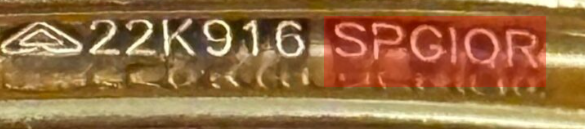
Since 2021, every hallmarked article carries exactly three marks
BIS Logo
The triangle mark confirming the article meets Indian Standards
Purity Grade
Expressed in karat and fineness — e.g. 22K916
6-digit HUID
Unique alphanumeric code linking the piece to a national database
The older Hallmarking system (2000–2021) included the BIS logo, purity, hallmarking centre logo and jeweller's mark. This was dropped in 2021 because all the information about hallmarking centre and retailer is now digitally captured within the HUID record.
Note: The BIS hallmark stamp is very tiny. To put its size into perspective, it is often as small and difficult to read as the nutritional information printed on the back of a chocolate bar.
APPROVED GRADES
Purity Grades Under BIS Hallmarking
Only these seven purity grades are officially recognised. Any other stamp is not BIS-certified.
24K
999
Purity 99.9%
24K
995
Purity 99.5%
23K
958
Purity 95.8%
22K
916
Most common in India
20K
833
Purity 83.3%
18K
750
Purity 75%
14K
585
Purity 58.5%
9K
375
New 2025
POLICY HISTORY
From Voluntary to Mandatory: The Phase-by-Phase Rollout
BIS hallmarking launched in April 2000 as a voluntary scheme. For 21 years, only ~30% of Indian gold jewellery carried a hallmark. Mandatory rollout began June 2021.
Mandatory hallmarking is currently active in 380+ districts (as of Phase 6). India has approximately 780 districts total. Even in non-mandatory districts, around 80% of jewellers now voluntarily sell hallmarked jewellery — because informed consumers increasingly demand it.
DIGITAL TRACEABILITY
The HUID: India's Gold Hallmark Verification System
A 6-digit alphanumeric code assigned to every individual piece of jewellery at the moment of hallmarking. No two pieces share the same code.
6-digit
Alphanumeric HUID — unique to every single piece
100 lakh+
BIS Care app downloads as of May 2026
Oct 2025
Photo + weight of each piece now visible in app
HUID works like an Aadhaar number for jewellery — every hallmarked piece gets a unique identification code that helps track and verify it individually.
The HUID links a physical piece of gold to a digital record that contains: the jeweller's identity and BIS registration number, the AHC that tested it, the purity certified, the article type, and the date of hallmarking. From October 23, 2025, the record also includes a photograph of the piece and its weight as registered — the most significant anti-fraud upgrade since HUID launched.
Any consumer can enter the HUID in the BIS Care app (Android / iOS, free) and instantly verify everything on record. This takes under 10 seconds and requires no technical knowledge. However, since this feature was introduced recently, many older pieces hallmarked before the rollout may not yet show images or these additional details.
What the October 2025 update means: Before this update, a fraudster could take a legitimate HUID from a higher-value article and re-stamp it on a low-value article. The app would confirm the HUID as genuine — but it was actually the code for a different piece. Now, the app shows the original photograph and registered weight. Any mismatch between what you see on screen and what you are holding is an immediate red flag.
THE BIS CARE APP
Inside the BIS Care App: HUID Verification in 20 Seconds
The official app for verifying gold hallmarks, locating AHCs, and staying updated on hallmarking policy changes — available free on Android and iOS.
What the October 2025 update means: Before this update, a fraudster could take a legitimate HUID from a higher-value article and re-stamp it on a low-value article. The app would confirm the HUID as genuine — but it was actually the code for a different piece. Now, the app shows the original photograph and registered weight. Any mismatch between what you see on screen and what you are holding is an immediate red flag.
Steps to Check the Purity / Hallmark Details of a Jewellery Piece
1. Download and open the BIS Care app on your mobile phone.
Select the “Verify HUID” option.
2. Enter the 6-digit HUID code engraved on the jewellery.
3. Click on “Search” to view the registered details of the hallmarked item and verify its authenticity.
FOR OLDER GOLD
Gold Bought Prior to 2021
Customers selling gold jewellery purchased before the introduction of HUID (July 2021) do not need to re-hallmark or re-stamp the jewellery before selling it. The absence of HUID does not affect the valuation because gold buyers primarily evaluate the purity, net gold weight, and market gold rate, not the hallmark format.
However, in districts where hallmarking is mandatory, Jewellers are prohibited from selling older 4-mark jewellery as "new" stock. Older non-HUID jewellery may still exist legally in households and can be sold, exchanged, melted, or recycled, but selling it again as newly hallmarked jewellery is prohibited by current BIS rules.
LAB TESTING
How Purity Is Tested at AHCs
All BIS-recognised Assaying and Hallmarking Centres use two approved testing methods.
XRF — X-Ray Fluorescence (Primary Screening)
A non-destructive test that quickly checks the surface composition of jewellery to estimate gold purity without damaging the piece.
Fire Assay / Cupellation (Confirmatory Standard)
A highly accurate confirmatory test that uses a small sample from the jewellery to determine the exact gold purity.
YOUR LEGAL RIGHTS
Your Consumer Rights Under BIS Hallmarking Rules
If you have hallmarked jewellery retested at an AHC and find the actual purity is lower than the hallmarked purity, the jeweller who sold it must pay you 2 times the monetary value of the purity shortfall — plus testing charges.
How the 2× rule works
You buy a 10-gram bangle hallmarked 916 (22K). AHC retesting finds it is actually 875 fineness. Shortfall: 916 − 875 = 41 parts per thousand = 0.41g of pure gold. At ₹6,000 per gram of 24K gold, the shortfall value is ₹2,460. The jeweller must pay 2 × ₹2,460 = ₹4,920 + testing charges. You do not need a court order to claim this.
KNOW THE RISKS
Hallmarking Fraud — Know What to Look For
Despite the HUID system's sophistication, fraudsters have adapted. Three categories of fake hallmarking — collectively known as the 'kaccha hallmark' scam — are actively observed.
Real enforcement case
On February 20, 2024, BIS officials raided a jeweller in Mira Road, Mumbai, and found gold jewellery being sold using the old 4-mark hallmark without HUID — illegal under the mandatory hallmarking order. The stock was confiscated and legal action was initiated under Section 17(1)(a) of the BIS Act 2016.
To understand this in detail, refer to the link below.
https://www.pib.gov.in/PressReleaseIframePage.aspx?PRID=2007818®=3&lang=2
To protect yourself from such frauds, always purchase jewellery only from BIS-registered jewellers and ensure the piece carries a valid HUID hallmark. Also, insist on receiving a proper tax invoice (pakka bill) with an IRN number, as it serves as proof of purchase and helps in case of future verification, complaints, exchange, or compensation claims.
Get the real value of your gold
Now you know what a BIS hallmark means, how to verify HUID in seconds, and what you're legally owed if a hallmarked piece falls short on purity. When you're ready to find out what your gold is actually worth, AsliValue's evaluation is done at your home, in front of you, with a full price breakdown before any decision is made.